
You cannot make fireworks disappear. But you can make the evening safer and less frightening.
What to do tonight
1. Get your dog somewhere safe.
Choose a room where your dog already feels comfortable. Ideally, it should be away from large windows and external doors.
A bedroom, internal hallway or quiet corner of the living room may work.
Give your dog somewhere to retreat: a familiar bed, an open crate they already enjoy using, or a covered space beneath a table.
Never force a frightened dog into a crate they are not comfortable with. A panicking dog may injure themselves trying to escape.
2. Close the curtains and secure the house.
Fireworks are not just loud. The flashes can also be frightening.
Draw the curtains, close the windows and reduce what your dog can see and hear outside.
Check external doors, garden gates and any other possible escape routes.
Dogs in a panic can behave very differently from their usual selves. Even a dog with excellent recall may bolt if suddenly frightened.
3. Stay with your dog.
Your presence matters.
Sit somewhere nearby. Speak normally. If your dog wants to lie next to you, let them.
If they prefer to hide beneath furniture, do not drag them out.
You do not need to keep touching them or asking them to perform commands. Sometimes simply being available is enough.
4. Use steady background sound.
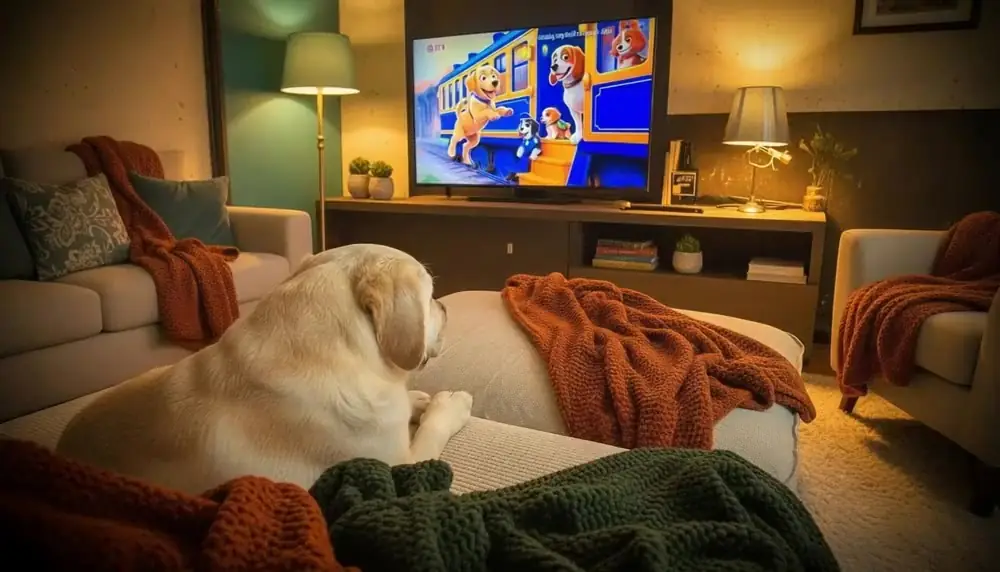
Music, a fan or low-volume television audio can help soften the contrast between silence and sudden explosions.
Choose something consistent, without dramatic changes in volume.
The aim is not to drown out fireworks completely. That is usually impossible without making the indoor environment unpleasantly loud.
Instead, provide a more predictable sound environment.
5. Offer something familiar to do.
If your dog is still interested in food, offer a favorite chew, a stuffed food toy or an easy sniffing activity.
Licking, chewing and searching for food may help some dogs settle.
If your dog refuses food, do not insist. A very frightened dog may be too stressed to eat.
Do not turn the evening into a training session.
6. Let your dog respond naturally.
Some dogs hide. Others pace, tremble, pant or follow their owners from room to room.
Do not punish these behaviors.
Do not force your dog to investigate the noise, watch fireworks through the window or go outside to discover that nothing dangerous is happening.
Fear is not something a dog can switch off on command.
7. Avoid unnecessary trips outside.
If fireworks are expected, arrange the main walk and toilet break before dark.
During the display, keep your dog indoors wherever possible.
When going outside becomes necessary, use a secure, properly fitted harness or collar and a lead, even in a familiar garden.
The RSPCA's fireworks guidance supports these practical steps: secure shelter, reduced visual and auditory stimulation, and calm human company.
Why fireworks hit dogs so much harder than us
Dogs hear a wider range of frequencies than humans and are particularly sensitive to certain sounds we may barely notice.
Their ears are built to detect information from the environment. That ability is useful when listening for distant movement or recognizing familiar signals.
But fireworks create a very different situation.
An explosion can arrive without warning. It may be followed by silence, then another explosion from a completely different direction.
There is no reliable rhythm.
For a dog, this unpredictability matters.
Humans understand what fireworks are. We know that a celebration is happening, that the sounds are temporary and that the explosions are usually taking place at a distance.
A dog has no way to understand that explanation.
They hear sudden, powerful noises without knowing their source or whether they represent danger.
There may also be vibrations, flashes and unfamiliar smells.
Some dogs barely react. Others experience intense fear.
Previous bad experiences, individual sensitivity, health and age can all influence that response.
The Cornell University College of Veterinary Medicine describes fireworks and thunderstorms as common causes of canine fear, with reactions ranging from mild unease to severe panic.
This is not stubbornness or disobedience.
It is a genuine fear response.
The myth that is making it worse
One of the most persistent pieces of advice about frightened dogs is also one of the least helpful:
"Don't comfort your dog. You'll reward their fear."
Comforting a frightened dog does not reinforce the emotion of fear.
Fear is not a trick the dog performs to receive attention.
A frightened dog is experiencing something unpleasant. Offering reassurance does not teach them to become more frightened.
Veterinary behavior experts at Tufts University's Cummings School of Veterinary Medicine explicitly reject the idea that comforting a dog during fireworks makes the fear worse.
If your dog comes to you shaking, you can stroke them.
You can speak softly.
You can let them curl up against you.
None of this means you are teaching them that fireworks are dangerous.
What matters is respecting what your dog finds comforting.
Some dogs actively seek physical contact. Others become more uncomfortable when held or restrained.
Follow their signals.
If they move away, allow it. If they settle beside you, stay there.
There is also no reason to exaggerate your own reaction. You do not have to become excessively cheerful every time a firework explodes.
Behave as normally as possible.
You can acknowledge that your dog is frightened without becoming frightened yourself.
Comfort will not necessarily remove the fear. A dog with a serious noise phobia may remain distressed even in your arms.
That does not make your presence pointless.
It means the dog needs additional support.
What to prepare in the weeks before
Everything above is about managing tonight.
Changing how a dog feels about fireworks is a different process. It takes preparation, repetition and patience.
The main approaches are called desensitization and counterconditioning.
Desensitisation means introducing a frightening sound at an intensity low enough that the dog remains comfortable.
Counterconditioning means pairing that sound with something positive, such as food or play.
For example, you might play a recording of distant fireworks at a barely audible volume while your dog enjoys a favorite treat.
Over multiple sessions, the volume may be increased very gradually.
The important word is gradually.
If your dog begins trembling, hiding, barking in distress or refusing food, the exercise has become too difficult.
Reduce the intensity or stop.
Playing loud fireworks recordings to force a dog to become accustomed to them is not desensitization. It can make the problem worse.
Recordings also cannot reproduce every part of real fireworks, including vibration and unpredictable direction.
A qualified clinical animal behaviorist can help design an appropriate program, especially for dogs with established fears.
The British Small Animal Veterinary Association recommends addressing serious noise fears well before fireworks season.
Preparation also means creating positive associations with a safe space when nothing frightening is happening.
Leave the bed or retreat accessible. Occasionally offer a chew there. Allow your dog to enter and leave freely.
Over time, it can become somewhere they choose to relax.
Background sound can be part of this routine, too. Siesta creates dog-focused animation with steady, low-tempo audio and no sudden sound peaks, which may help soften the quiet gaps between bangs when some dogs become tense.
But sound is only one tool. It cannot replace a secure environment, appropriate treatment or the reassuring presence of a person.
When it is time to call the vet
Some dogs are not simply startled by fireworks.
They experience severe noise phobia.
Signs can include prolonged trembling, frantic attempts to escape, excessive panting, destructive behavior, complete refusal of food or an inability to settle long after the noise stops.
This is a real, treatable veterinary and behavioral condition.
If your dog has experienced these reactions before, arrange an appointment with your vet well before the next expected fireworks event.
Your vet can assess possible medical factors, discuss treatment options and recommend a qualified behaviorist.
Some dogs benefit from a combination of behavioral treatment and veterinary-prescribed support.
Do not give human medication or unprescribed calming products.
And do not wait until the first explosion on New Year's Eve to ask for a treatment plan.
If your dog is currently panicking severely, has injured themselves or is in immediate danger, contact an emergency veterinary service.
For tonight, focus on safety, predictability and companionship.
You may not be able to stop every frightened reaction. You can still make sure your dog does not have to face it alone.
Questions
Does comforting a frightened dog make the fear worse?
No. Comforting a frightened dog does not reinforce fear. If your dog comes to you, you can stroke them and speak softly.
Should I leave the TV or music on during fireworks?
Steady background sound can help soften the contrast between silence and explosions. Choose something without sudden volume changes.
When should I call the vet about fireworks fear?
Before the next expected display, not on the night. Severe noise phobia is a real and treatable condition.
For more practical ideas, read the free guide. Take the test